Whether you’re replacing an old interior door, fixing a drafty entryway, or planning a new installation, understanding basic door terminology is essential. Yet many homeowners — and even some DIYers — often confuse terms like door frame, door jamb, casing, threshold, and trim because they all work together as part of the same opening.
One of the most common questions is: “Is a door jamb the same as a door frame?”
The answer is no. A door jamb is one component of the overall door frame system, but the complete frame includes several structural and decorative parts that each serve different functions.
In this guide, we’ll break down the anatomy of a doorway using simple explanations, visual comparisons, and practical examples. By the end, you’ll clearly understand the differences between a door frame, jamb, casing, stop, threshold, and related components — making it much easier to communicate with contractors, order replacement parts, or confidently plan your next door project.
What Is a Door Frame? Understanding the Complete Door Structure
A door frame is the full structural assembly installed within a wall opening that supports, secures, and surrounds the door system. It typically consists of the head jamb (top section), two side jambs (vertical sections), and, for exterior doors, a sill or threshold at the bottom.
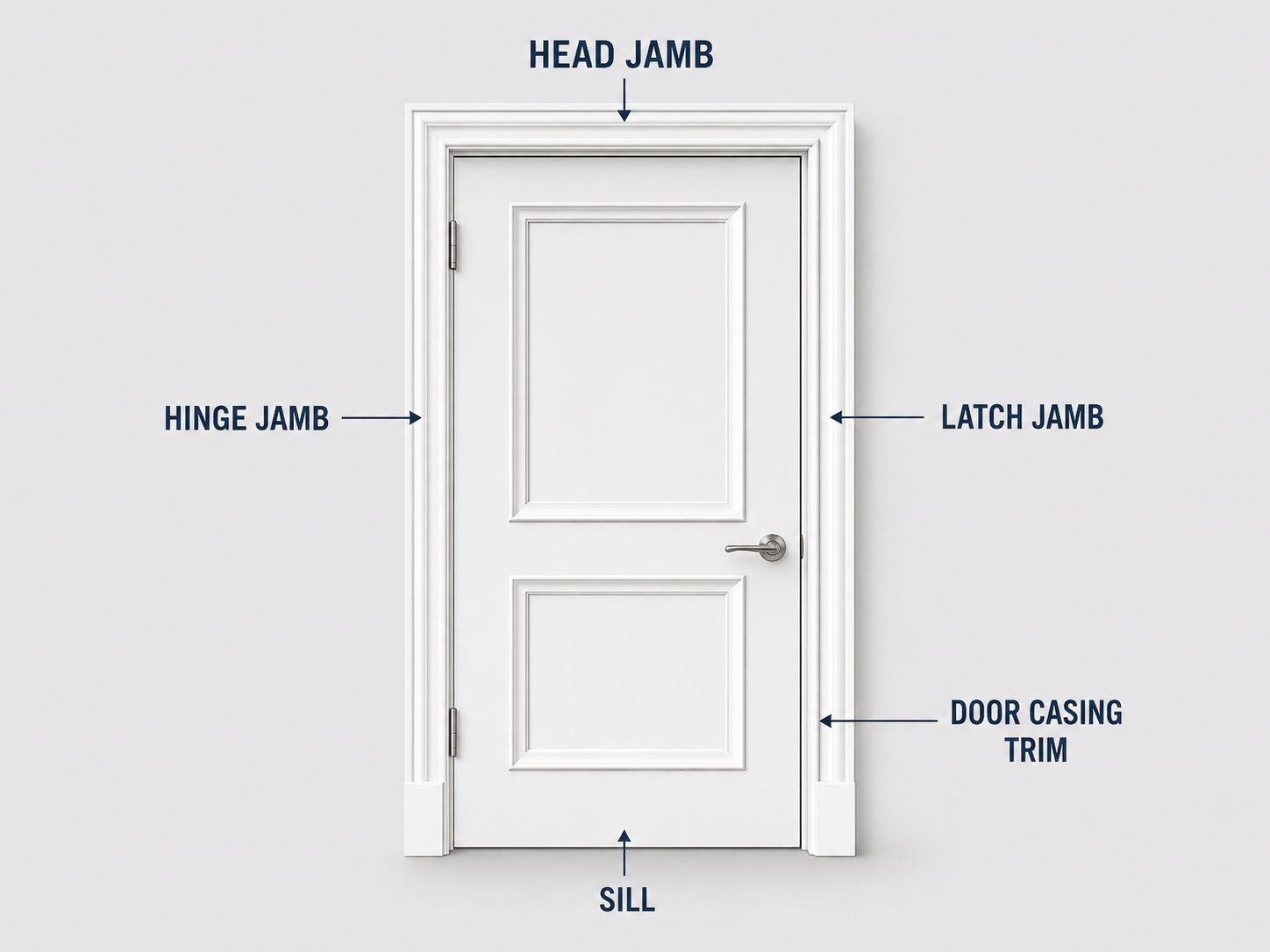
Think of the door frame as the structural foundation of the doorway. It creates the finished opening that allows the door to operate smoothly while also providing strength, alignment, and weather protection.
A properly installed door frame is responsible for:
- Supporting the weight of the door
- Keeping the opening square and stable
- Allowing smooth opening and closing
- Providing sealing surfaces for insulation and weather resistance
- Connecting the door system cleanly to the surrounding wall structure
Main Components of a Door Frame
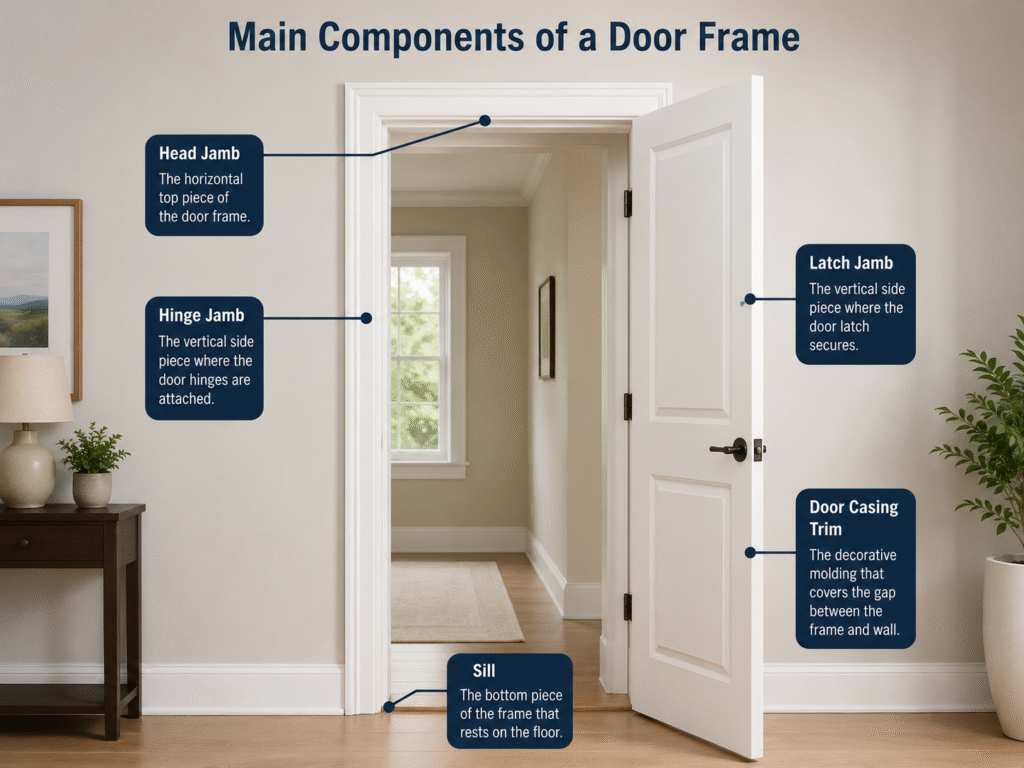
Head Jamb (Top Section)
The horizontal structural piece located across the top of the doorway.
Side Jambs
The two vertical sections running along each side of the opening. These support hinges, strike plates, and locking hardware.
Sill or Threshold
The bottom section commonly found on exterior doors to help manage water drainage, air sealing, and weather protection.
Door Stop
Thin strips attached to the jambs that stop the door from swinging completely through the frame and help create a tighter seal when closed.
Key Difference to Remember
The door frame refers to the entire structural doorway assembly, while components like the jamb, stop, or threshold are individual parts within that complete frame system.
What Is a Door Jamb? The Structural Core of the Door Frame
A door jamb refers to the vertical structural sections of a door frame where the door is mounted and secured. One jamb supports the hinges, while the opposite jamb contains the strike plate where the latch or lock engages.
If the door frame is the overall structure of the doorway, the jambs are the primary load-bearing components that keep the door aligned, stable, and operating correctly.
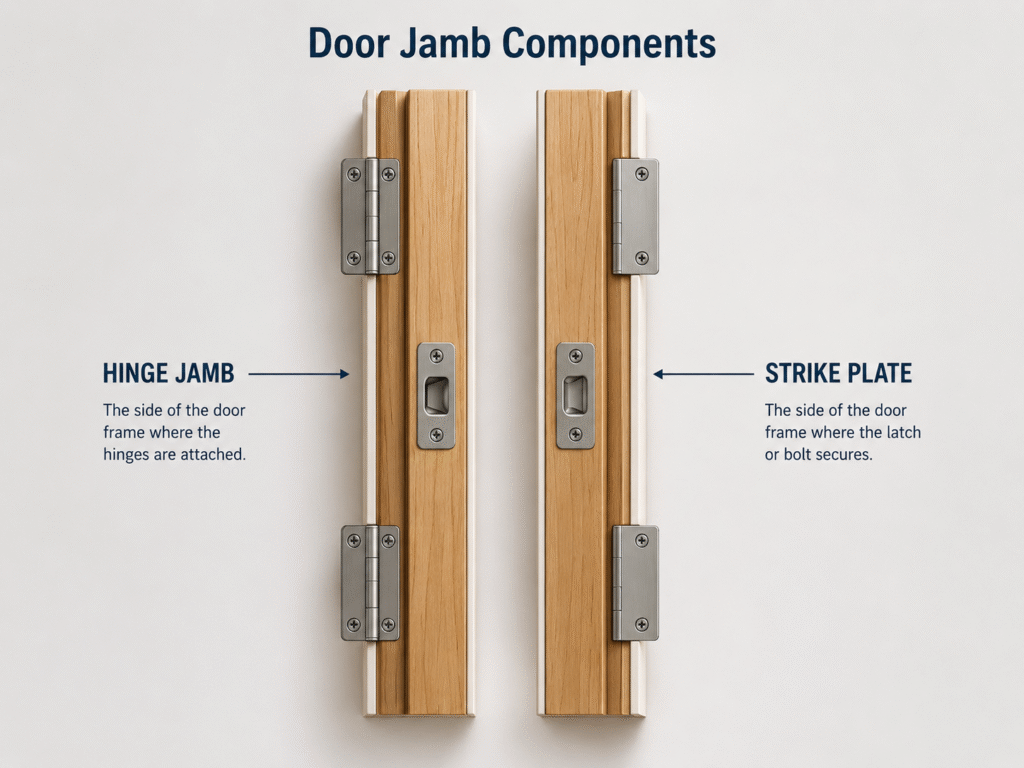
The Three Main Types of Door Jambs
Hinge Jamb
The vertical jamb where the door hinges are installed. This side supports the full operating weight of the door.
Latch Jamb (Strike Jamb)
The opposite vertical jamb that contains the strike plate and locking points for the latch or deadbolt system.
Head Jamb
The horizontal top section connecting both side jambs. While technically part of the jamb system, it is commonly referred to separately as the header or top jamb.
Main Functions of a Door Jamb
Door jambs perform several critical structural and operational functions:
- Support the door through hinge hardware
- Hold strike plates and locking components
- Provide mounting surfaces for door stops and trim
- Help create weather-tight sealing surfaces on exterior doors
- Maintain proper alignment for smooth opening and closing
Standard Door Jamb Dimensions
Typical Jamb Widths
Door jamb width must match the finished wall thickness.
- Interior walls: typically 4-9/16″
- Exterior walls: typically 6-9/16″
Standard Thickness
Most jambs range from approximately 3/4″ to 1-1/16″ thick depending on door type and material.
Common Materials
- Interior jambs: Pine, poplar, oak, MDF
- Exterior jambs: Treated wood, fiberglass, steel, or aluminum systems
Important Installation Note
When replacing a door or ordering a new pre-hung system, accurate jamb width measurement is essential. A mismatched jamb depth can create installation issues, uneven trim alignment, and poor sealing performance.
For modern residential and commercial entry systems, explore premium Aluminum Door Solutions by Zumwin designed for durability, energy efficiency, and contemporary architectural projects.
Door Casing vs. Door Jamb: Understanding the Key Difference
One of the most common door terminology mistakes is confusing the door jamb with the door casing. While these components work together around the same opening, they serve completely different purposes.
Simply put:
- The door jamb is structural.
- The door casing is decorative.
The jamb supports the door itself, while the casing finishes the appearance of the doorway by covering the gap between the frame and the wall surface.
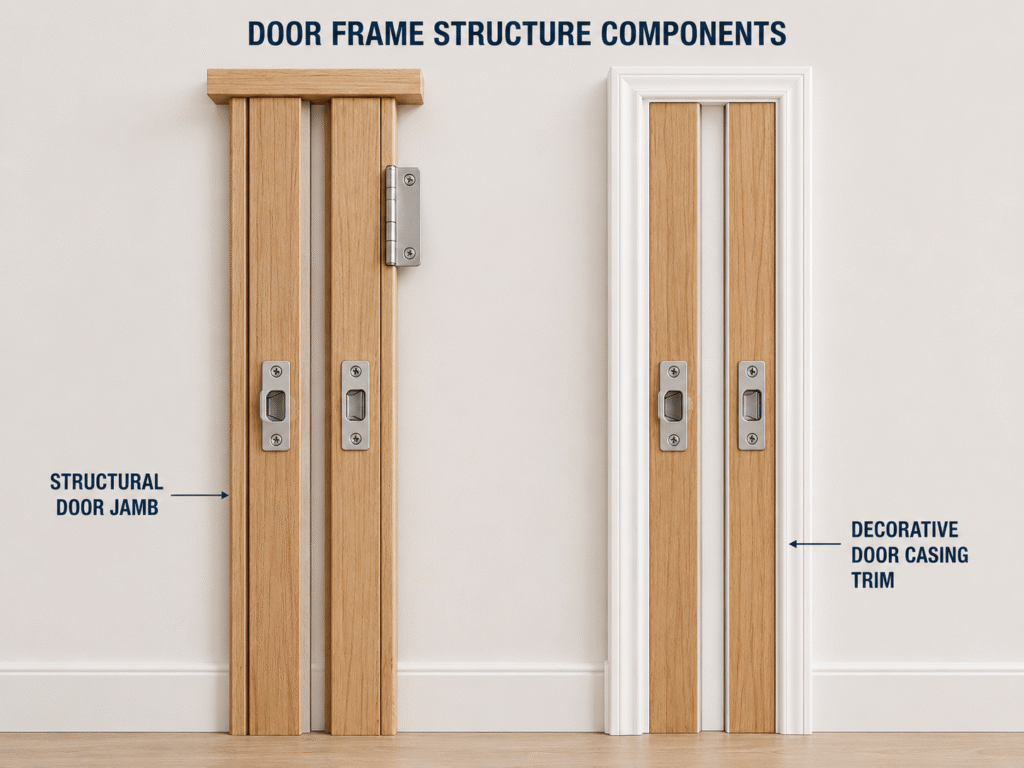
Door Jamb (Structural Component)
Location
Installed inside the wall opening as part of the door frame assembly.
Main Purpose
- Supports the weight of the door
- Holds hinges, strike plates, and locking hardware
- Keeps the door aligned and operating properly
Materials
Typically made from:
- Solid wood
- Composite materials
- Steel
- Fiberglass
- Aluminum systems
Installation
Door jambs are shimmed, leveled, and securely fastened directly to the rough opening framing.
Important Note
If the jamb is removed, the door system can no longer function properly because the structural support is gone.
Door Casing (Decorative Trim)
Location
Installed on the wall surface surrounding the door frame.
Main Purpose
- Covers gaps between drywall and frame
- Improves appearance
- Adds architectural style and detail
Materials
Common casing materials include:
- Wood
- MDF
- PVC
- Polyurethane decorative trim
Installation
Casing is typically nailed or adhered to the wall surface and edge of the jamb after the frame is installed.
Important Note
Removing the casing does not affect door operation because it is not a structural component.
Simple Rule to Remember
A quick way to identify the difference:
- If removing it affects the structural operation of the door, it is part of the jamb or frame.
- If removing it only changes the appearance, it is casing or trim.
Key Differences at a Glance: Door Frame vs. Door Jamb vs. Door Casing
Although these terms are often used interchangeably, a door frame, door jamb, and door casing are completely different components within a doorway system.
- The door frame is the complete structural assembly installed inside the wall opening.
- The door jamb refers to the vertical and top structural sections that support the door itself.
- The door casing is the decorative trim applied around the frame to finish the appearance of the opening.
Understanding the distinction between these components is essential when replacing doors, ordering pre-hung systems, discussing installation details with contractors, or troubleshooting operational issues.
Quick Reference Comparison
| Component | Primary Role | Main Function | Location | Simple Analogy |
|---|---|---|---|---|
| Door Frame | Structural | Complete doorway support system | Inside rough wall opening | Skeleton |
| Door Jamb | Structural | Supports hinges, locks & door weight | Vertical & top sections of frame | Spine & ribs |
| Head Jamb | Structural | Top horizontal support section | Top of doorway | Skull |
| Door Casing | Decorative | Covers wall gaps & adds style | Wall surface around frame | Picture frame |
| Door Stop | Functional | Stops door from swinging through | Attached to jamb interior | Bumper |
| Sill / Threshold | Structural & Weatherproofing | Seals and protects bottom opening | Base of exterior doorway | Foundation |
Exterior vs. Interior Door Frames: What’s the Difference?
Exterior and interior door frames are designed for very different performance requirements. While interior systems focus mainly on appearance and functionality, exterior frames must also provide weather resistance, insulation, drainage, and security protection.
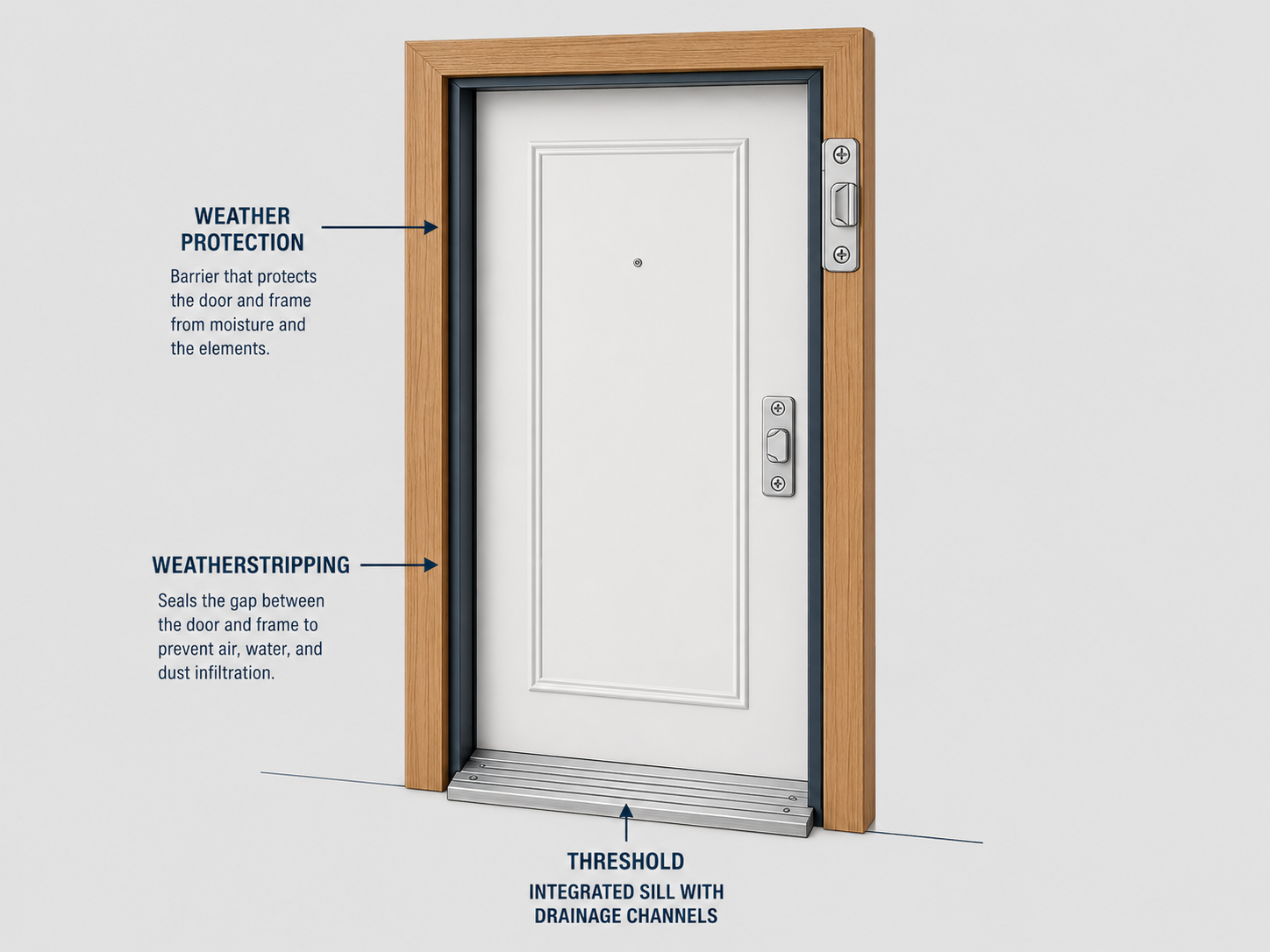
Exterior Door Frames & Jamb Systems
Exterior door frames are engineered to withstand moisture, temperature changes, wind exposure, and long-term structural movement.
Key Difference: Sill & Threshold System
Unlike interior doors, exterior systems include a sill and threshold assembly at the base of the opening.
- Door Sill: A sloped structural base designed to direct water away from the opening.
- Threshold: The visible surface stepped over when entering or exiting the home.
Together, these components create a weather-resistant seal that helps prevent water intrusion, air leakage, and energy loss.
Common Exterior Door Frame Materials
Treated Wood
Traditional appearance with stain or paint flexibility, but requires regular maintenance to prevent moisture damage.
Fiberglass
Highly durable, energy-efficient, and resistant to rot, warping, and corrosion. Ideal for low-maintenance exterior systems.
Steel
Provides excellent strength and security performance with strong structural stability.
PVC & Composite Systems
Designed for moisture resistance, dimensional stability, and minimal maintenance requirements.
Exterior Frame Construction Features
Compared to interior door systems, exterior frames commonly include:
- Thicker and reinforced jamb construction
- Integrated weatherstripping systems
- Reinforced strike plate areas for security
- Sill drainage channels for water management
- Higher-performance sealing and insulation components
These structural upgrades improve long-term durability, thermal efficiency, weather resistance, and overall entry system performance.
For modern residential and commercial projects, explore premium Aluminum Door Systems by Zumwin designed for contemporary architecture, energy efficiency, and long-term durability.
Additional Door Frame Components Explained
Beyond the main frame, jambs, and casing, a complete door system includes several smaller but essential components that affect operation, sealing, durability, and appearance. These parts work together to improve door performance, weather protection, and long-term reliability.
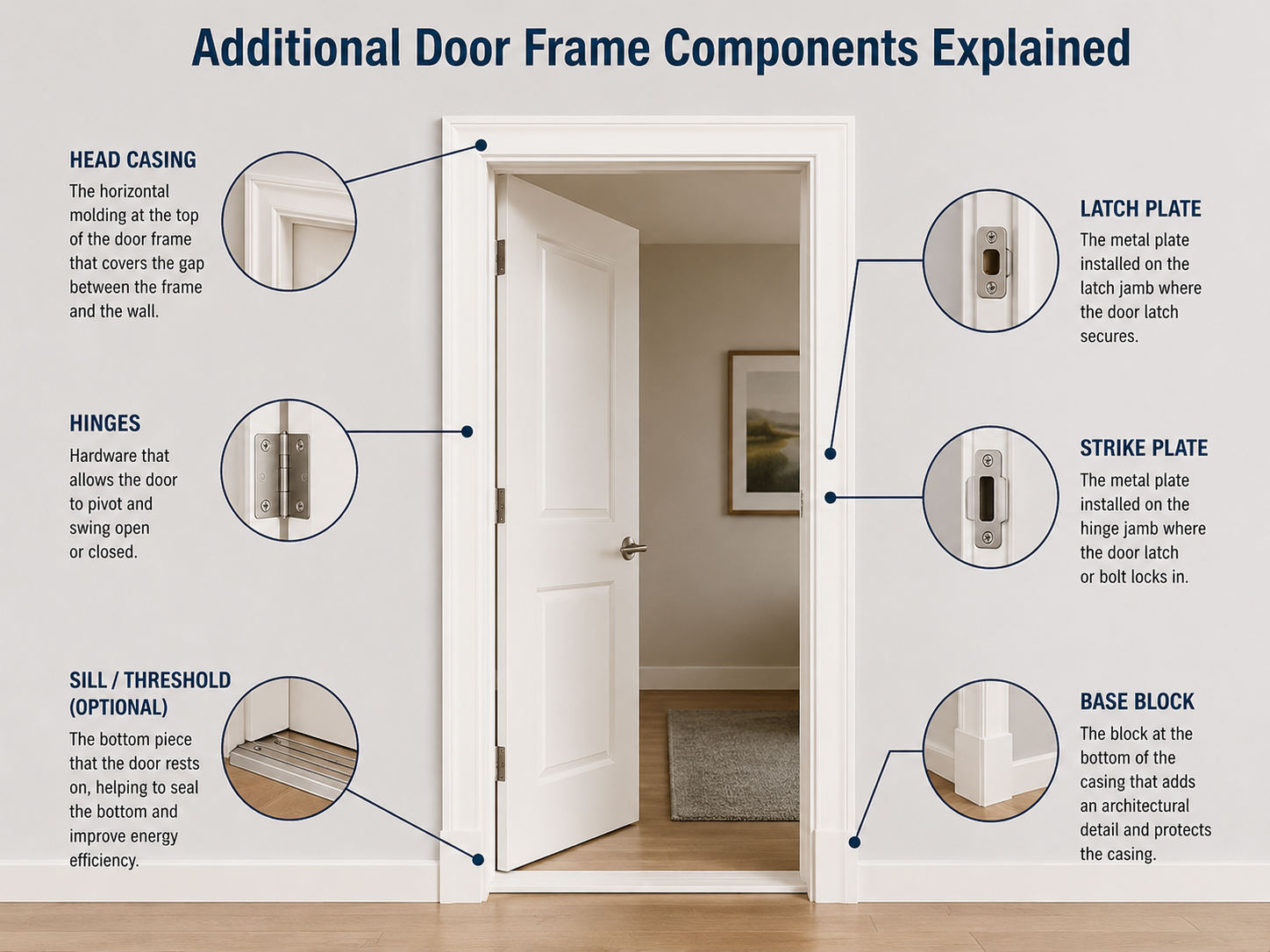
Doorstop (Door Stop Molding)
What It Is
Doorstops are narrow strips of wood or composite material — typically around 1/4″ × 1-1/4″ — attached to the inside face of the door jamb.
Main Functions
- Prevent the door from swinging through the frame
- Create a sealing surface when the door closes
- Help position the door flush within the opening
Types of Door Stops
Applied Doorstop
Separate trim pieces fastened directly onto the jamb. This is the most common and easiest style to repair or replace.
Integral Doorstop
Machined directly into the jamb itself for a cleaner appearance and more permanent construction.
Weatherstripping
What It Is
Weatherstripping is compressible sealing material — usually foam, rubber, vinyl, or silicone — installed around exterior door jambs and thresholds.
Main Functions
- Seal gaps between the door and frame
- Reduce drafts and energy loss
- Prevent moisture intrusion
- Improve sound insulation
Proper weatherstripping plays a major role in exterior door energy efficiency and weather resistance.
Threshold
What It Is
The threshold is the raised bottom component located beneath an exterior door opening.
Main Functions
- Creates a weather seal at the base of the doorway
- Supports adjustable sweeps and sealing systems
- Provides a clean transition between flooring surfaces
Because thresholds experience constant foot traffic and weather exposure, they typically wear faster than other frame components and may eventually require replacement.
Brick Mould (Exterior Trim)
What It Is
Brick mould is the wider decorative trim installed around the exterior perimeter of an exterior door frame.
Main Functions
- Covers the gap between the frame and siding
- Creates a finished exterior appearance
- Protects the frame-to-wall connection from moisture exposure
Brick mould is commonly used on traditional residential exterior door systems.
When to Repair vs. Replace Door Jambs & Frames
Minor door jamb damage can often be repaired successfully, while larger structural problems usually require full frame replacement.
Common Door Jamb Problems (Often Repairable)
1. Stripped Hinge Screw Holes
Symptoms
- Sagging door
- Loose hinges
- Poor alignment during closing
Typical Repair
Remove damaged screws, reinforce holes with wood glue and dowels or toothpicks, then reinstall screws with fresh pilot holes.
Typical Cost
- DIY: $5–$10
- Professional: $50–$100
Typical Time
Approximately 30 minutes per hinge.
2. Cracked Wood Near the Strike Plate
Symptoms
- Visible cracks around latch area
- Loose strike plate
- Difficulty latching properly
Typical Repair
Fill cracks with wood filler and reinforce the strike area using longer screws anchored into wall studs.
Typical Cost
- DIY: $10–$20
- Professional: $75–$150
Typical Time
Around 1 hour.
3. Minor Rot at the Bottom of an Exterior Jamb
Symptoms
- Soft or discolored wood near threshold
- Localized moisture damage
Typical Repair
Cut away the damaged section, splice in new treated wood, then reseal and repaint the area properly.
Typical Cost
- DIY: $30–$60
- Professional: $150–$300
Typical Time
Approximately 2–3 hours.
Prevention Tip
Proper threshold sealing and weatherstripping maintenance help prevent future moisture damage.
4. Door Not Latching Properly
Symptoms
- Door will not stay closed
- Latch misses strike plate
- Uneven door gaps
Typical Repair
Adjust strike plate alignment or re-shim the jamb to square the frame properly.
Typical Cost
- DIY: $0–$20
- Professional: $100–$200
Typical Time
30 minutes to 2 hours depending on alignment issues.
Common Door Frame Problems (Usually Require Replacement)
1. Widespread Rot or Termite Damage
Symptoms
- Multiple soft or damaged frame areas
- Structural deterioration
- Severe moisture damage
Recommended Solution
Complete frame replacement.
Typical Cost
- Frame only: $400–$1,200
- Full pre-hung system with door: $800–$3,000+
Why Replacement Is Recommended
Structural integrity becomes compromised, and repair costs often approach replacement pricing.
2. Severely Warped or Out-of-Square Frames
Symptoms
- Large uneven gaps
- Door binding in several locations
- Difficulty opening or closing
Recommended Solution
Full frame replacement.
Typical Cost
$500–$1,500+
Why Replacement Is Recommended
Severely distorted frames are difficult to re-square permanently and often continue causing operational issues.
3. Forced Entry or Security Damage
Symptoms
- Split jambs
- Damaged strike plate areas
- Broken thresholds or frame sections
Recommended Solution
Full frame replacement with upgraded security reinforcement.
Typical Cost
$600–$2,000+
Why Replacement Is Recommended
Structural damage weakens security performance and creates long-term reliability concerns.
4. Upgrading from Single to Double Doors
Symptoms
- No damage present
- Homeowner wants larger entry configuration
Recommended Solution
Complete new frame installation with wall reframing modifications.
Typical Cost
$1,200–$4,000+
Important Consideration
These upgrades usually require structural framing changes and larger rough openings.
Repair vs. Replace: Quick Cost Comparison
| Scenario | Repair Cost | Replace Jamb Only | Replace Full Pre-Hung | Best Choice |
|---|---|---|---|---|
| One loose hinge | $50–$100 | N/A | N/A | Repair |
| Cracked strike area | $75–$150 | $200–$400 | $800–$1,500 | Repair |
| Bottom rot (single jamb) | $150–$300 | $250–$500 | $800–$1,500 | Repair or jamb replacement |
| Multiple jamb issues | $300–$600 | $400–$700 | $800–$1,500 | Replace pre-hung |
| Entire frame rotted | N/A | N/A | $1,000–$3,000+ | Replace pre-hung |
Professional Recommendation
If more than one jamb is damaged or the frame has widespread moisture, alignment, or structural issues, replacing the entire pre-hung door system is often the most cost-effective and reliable long-term solution.
For modern residential and commercial applications, explore premium Aluminum Door Systems by Zumwin designed for durability, thermal efficiency, and contemporary architectural performance.
Understanding Pre-Hung Doors: The Complete Door System
A pre-hung door is a fully assembled door unit that includes the door slab, frame, hinges, and key structural components already factory-installed and aligned. Instead of purchasing individual parts separately, the entire system arrives ready to install directly into the rough opening.
Because the frame and door are pre-aligned at the factory, pre-hung systems typically provide easier installation, better operation, and improved long-term sealing compared to slab-only doors.
What Is Included in a Standard Pre-Hung Door?
Most pre-hung door systems include:
- ✅ Door slab (the actual door panel)
- ✅ Complete door frame (head jamb and side jambs)
- ✅ Hinges pre-installed and aligned
- ✅ Doorstop molding attached to the jambs
- ✅ Strike plate and latch preparation
Common Exterior Door Additions
Many exterior pre-hung systems also include:
- ✅ Factory-installed weatherstripping
- ✅ Sill and threshold assembly
- ✅ Exterior brick mould or trim
What Is Usually Not Included?
The following items are typically purchased separately:
- ❌ Interior door casing or trim
- ❌ Door handles and locksets
- ❌ Paint or stain finishing
- ❌ Installation shims and fasteners
Pre-Hung Doors vs. Slab-Only Doors
| Factor | Pre-Hung Door | Slab-Only Door |
|---|---|---|
| Includes | Door + frame + hinges | Door panel only |
| Typical Cost | $200 – $3,000+ | $50 – $1,500+ |
| Installation Difficulty | Moderate / DIY-friendly | Advanced carpentry required |
| Installation Time | 2–4 hours | 4–8 hours |
| Best For | New installs & damaged frames | Existing frames in excellent condition |
| Factory Alignment | Yes | No |
| Weather Sealing | Better overall performance | Depends on existing frame |
When Should You Choose a Pre-Hung Door?
Pre-hung systems are usually the best choice when:
- The existing frame is damaged or outdated
- You are installing a door in new construction
- You want improved weather sealing and alignment
- You prefer a faster and more predictable installation
- You are a homeowner handling a DIY installation
Because all components are factory-aligned, pre-hung doors also reduce the risk of operational issues such as binding, uneven gaps, or poor latching.
When Is a Slab-Only Door the Better Option?
A slab-only door may make sense when:
- The existing frame is perfectly square and undamaged
- You only want to change the door style
- Historic trim or frames must remain intact
- You have advanced carpentry experience
- Budget is the primary concern
However, slab installations require careful hinge mortising, latch alignment, trimming, and fitting, making them significantly more labor-intensive than pre-hung systems.
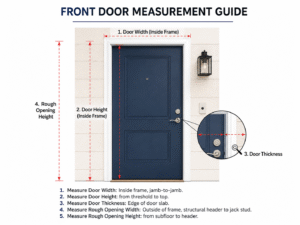
How to Measure Door Jambs for Replacement
Accurate door jamb measurements are essential for proper door fit, smooth operation, and clean trim alignment. When replacing a jamb or ordering a pre-hung door, you’ll need to measure jamb width, opening width, opening height, and frame squareness carefully.
As a general rule, always measure in multiple locations and use the smallest measurement to avoid installation issues.
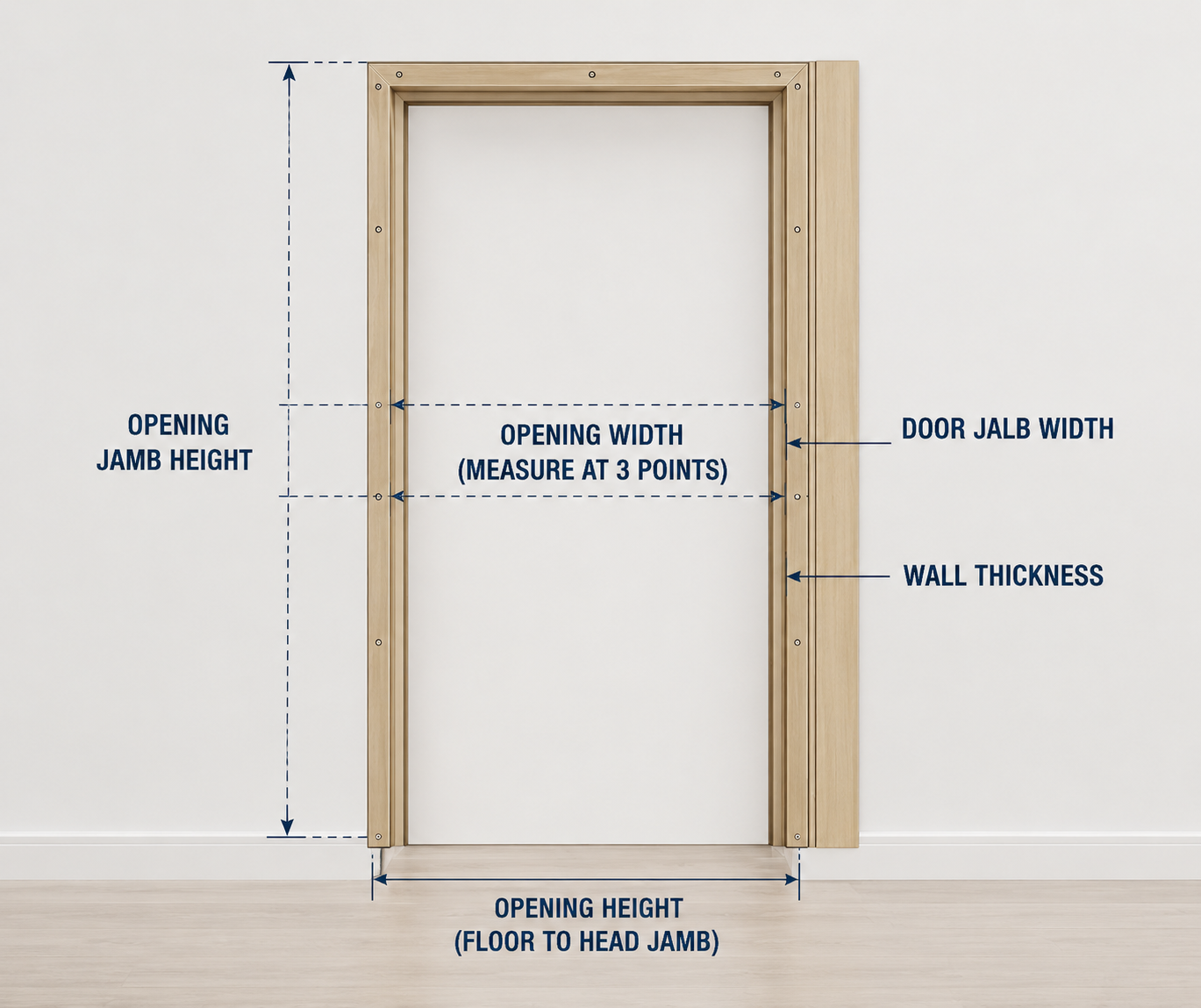
Step 1: Measure Jamb Width (Wall Depth)
Door jamb width must match the finished wall thickness exactly.
How to Measure
Measure from the finished interior wall surface to the finished exterior wall surface.
Common Jamb Widths
- Interior 2×4 walls: 4-9/16″
- Interior 2×6 walls: 6-9/16″
- Exterior walls: typically 6-9/16″ to 7-1/4″
Important Tip
Incorrect jamb depth can cause uneven trim alignment, poor sealing, and difficult installation.
Step 2: Measure the Door Opening Width
Measure the clear opening from the inside edge of one jamb to the inside edge of the opposite jamb.
Best Practice
Take measurements at:
- Top
- Middle
- Bottom
Always use the smallest measurement.
Common Interior Opening Widths
- 32″
- 34″
- 36″
Step 3: Measure the Door Opening Height
Measure vertically from the finished floor (or top of threshold/sill) to the bottom of the head jamb.
Best Practice
Measure both:
- Left side
- Right side
Use the smaller dimension if the measurements differ.
Standard Door Heights
- 80″ (6′8″)
- 96″ (8′0″)
Step 4: Check if the Frame Is Square
A square frame is critical for proper door alignment and smooth operation.
How to Check
Measure diagonally from corner to corner in both directions.
What to Look For
- If both diagonal measurements match, the frame is square.
- If measurements differ by more than 1/4″, the opening is considered out of square.
Important Note
Out-of-square jambs and frames often cause sticking, uneven gaps, poor latching, and weather sealing problems. In many cases, full frame replacement is the best long-term solution.
Material Choices for Door Jambs & Frames
Choosing the right door jamb and frame material affects durability, maintenance, moisture resistance, appearance, and long-term performance. Interior and exterior doors require very different materials because exterior systems must handle weather exposure, temperature changes, and security demands.
Interior Door Jamb Materials
Pine
Typical Cost
$80–$200 per frame
Advantages
- Affordable and widely available
- Easy to cut and install
- Paints well
- Lightweight and DIY-friendly
Considerations
- Softer wood that dents more easily
- Limited moisture resistance
Best For
Standard interior doors in bedrooms, closets, and low-moisture spaces.
Poplar
Typical Cost
$100–$250 per frame
Advantages
- Harder and more stable than pine
- Smooth surface for painted finishes
- Better resistance to warping
Considerations
- Higher cost than pine
- Not ideal for stained finishes due to natural green undertones
Best For
Higher-traffic interior areas where additional durability is desired.
MDF (Medium-Density Fiberboard)
Typical Cost
$60–$150 per frame
Advantages
- Budget-friendly
- Extremely smooth paint surface
- No knots or grain inconsistencies
Considerations
- Swells if exposed to moisture
- Less impact-resistant than solid wood
Best For
Paint-grade interior projects and cost-conscious renovations.
Hardwood (Oak, Maple, Cherry)
Typical Cost
$200–$500 per frame
Advantages
- Premium natural grain appearance
- Excellent durability and strength
- Ideal for stain-grade finishes
Considerations
- More expensive
- Heavier and harder to machine
- Requires proper finishing to prevent cracking or movement
Best For
Luxury homes and visible stained interior trim applications.
Exterior Door Jamb & Frame Materials
Exterior door systems require stronger, more weather-resistant materials capable of handling moisture, temperature changes, and long-term exposure.
Treated Wood
Typical Cost
$150–$400 per frame
Advantages
- Traditional appearance
- Can be painted or stained
- Easier to repair than synthetic materials
Considerations
- Requires periodic maintenance
- Vulnerable to rot if finishes fail
Best For
Traditional residential entry systems in moderate climates.
Fiberglass
Typical Cost
$300–$800 per frame
Advantages
- Extremely durable
- Will not rot or warp
- Low maintenance
- Excellent thermal performance
Considerations
- Higher upfront cost
- Limited style availability compared to wood
Best For
High-moisture regions, coastal climates, and energy-efficient homes.
Steel
Typical Cost
$200–$600 per frame
Advantages
- Exceptional strength and security
- Strong resistance to forced entry
- Fire-resistant construction
Considerations
- Can rust if protective coatings are damaged
- Conducts heat and cold more easily than insulated materials
- Heavier installation weight
Best For
Security-focused residential and commercial applications.
PVC & Composite Frames
Typical Cost
$250–$600 per frame
Advantages
- Completely rot-proof
- Excellent moisture resistance
- Minimal maintenance requirements
Considerations
- Thermal expansion in extreme temperatures
- Less structural rigidity than solid wood or steel
Best For
Coastal environments, humid climates, and low-maintenance exterior applications.
Professional Recommendation
For interior projects, pine and poplar remain the most common and cost-effective choices. For exterior systems, fiberglass and composite materials offer the best balance of durability, energy efficiency, and low maintenance, while solid wood remains the premium option for luxury architectural applications.
For modern residential and commercial projects, explore premium Aluminum Door Systems by Zumwin engineered for long-term durability, thermal performance, and contemporary design flexibility.
Frequently Asked Questions (FAQs)
Here are quick answers to the most common questions about door frames, door jambs, pre-hung doors, and replacement costs.
Is a door jamb the same as a door frame?
No. A door jamb is one structural component of the overall door frame system. The complete frame includes the head jamb, side jambs, and sometimes a sill or threshold. The jambs specifically support the hinges, strike plate, and door operation.
What is a pre-hung door?
A pre-hung door is a factory-assembled unit that includes the door slab, hinges, and full frame already aligned and attached together. It is designed to install directly into the rough opening, making installation faster and easier.
How do you measure a door jamb?
Measure the jamb width to match your wall thickness, then measure the opening height from the floor to the underside of the head jamb. Measure the opening width in three locations and always use the smallest measurement for accuracy.
Can you buy a door jamb by itself?
Yes. Individual jamb stock is available in multiple sizes and materials. However, many homeowners and contractors prefer complete pre-hung systems because they simplify installation and improve long-term alignment.
What is the top part of a door frame called?
The horizontal section at the top of the frame is called the head jamb or top jamb. It connects both side jambs and forms the upper structural section of the doorway.
What is the difference between interior and exterior door jambs?
Exterior jambs are thicker and built with weather-resistant materials, integrated sealing systems, and thresholds. Interior jambs are lighter-duty, use less expensive materials, and do not require weather protection.
Should you replace the entire frame or just the jamb?
Minor localized damage can often be repaired by replacing only the affected jamb. However, widespread rot, severe warping, structural damage, or multiple alignment problems usually make full frame replacement the better long-term solution.
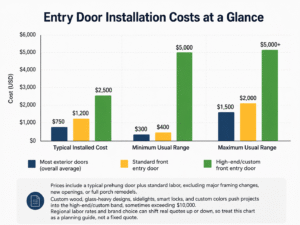
How much does door frame replacement cost?
Basic frame replacement materials typically range from $100–$500, while professional installation usually falls between $400–$1,200. Complete pre-hung door systems with installation commonly range from $800–$3,000+, depending on door type, material, and project complexity.
Conclusion: Understanding Door Components Matters
Understanding the differences between door frames, jambs, casing, thresholds, and other door components makes it much easier to plan repairs, replace doors correctly, and communicate confidently with contractors or installers. Each component plays a specific role in the structure, operation, weather sealing, and appearance of the overall doorway system.
Whether you are upgrading an interior door, replacing an exterior entry system, or planning a new construction project, selecting the right frame configuration and materials is essential for long-term durability, smooth operation, and energy efficiency. For modern residential and commercial projects, working with a professional Aluminum Door & Window Manufacturer can help ensure better performance, precision engineering, and long-lasting architectural results.